Modern Standard Arabic or dialect? Where best to start
Anyone who wants to start learning Arabic almost always asks the same question: Should I learn Modern Standard Arabic or go straight for a dialect? The answer has a big influence on how quickly you progress – and whether you’ll have to start all over again after your first course.
After many years of teaching, my recommendation is clear: Start with Modern Standard Arabic. A dialect can still be the right way in – it depends on your goal. Here’s why.
Modern Standard Arabic and dialects – what’s the difference?
Modern Standard Arabic (in Arabic Fuṣḥā) is the common language of all Arab countries. Books, newspapers, news, contracts and official texts are written in it. If you speak Modern Standard Arabic, you’ll be understood from Morocco to Oman.
Dialects are the everyday language of a country or region – Egyptian, Syrian, Moroccan, Gulf Arabic and many more. They are not separate languages but varieties of Arabic. Much of their vocabulary and grammar comes from Modern Standard Arabic.

Why we start with Modern Standard Arabic
- Clear rules: The grammar of Modern Standard Arabic is described systematically. That makes it easy to explain – and easier for you to remember new things. Dialects developed in everyday life, without fixed rules or a standard spelling.
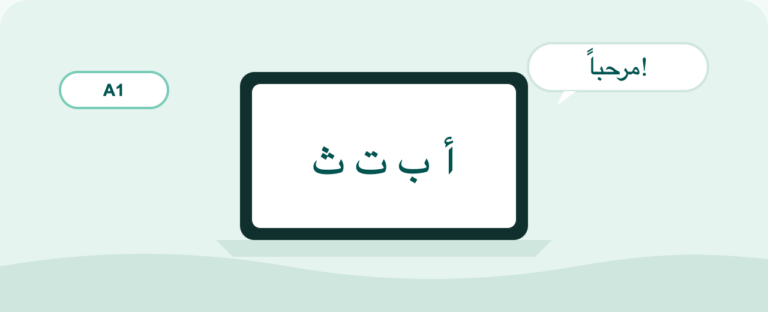
- Reading and writing: With Modern Standard Arabic you learn the script properly from the very beginning. So you can read signs, texts and messages yourself.
- Understood everywhere: Modern Standard Arabic connects all Arab countries. You’re not tied to one region.
- The best bridge to any dialect: If you know Modern Standard Arabic, you’ll recognise most words in any dialect and learn it much faster.
By the way, we do the same with other languages: nobody would learn German only in Bavarian dialect. You learn standard German – and then understand the dialects better and better.
In my experience as a teacher since 2008, one path has proven best: first Modern Standard Arabic, then the dialect. That way nothing is learned twice, and the dialect comes surprisingly quickly later on.
Aiman Eryani, founder of ArabVista
Can you start directly with a dialect?
Yes, that can work. If, for example, you mainly want to talk with your family or need a few sentences quickly for a trip to a particular country, a dialect course is a good way in. It works well for your first steps in everyday life.
The important thing is to know its limits: the further you get, the more often explanations need Modern Standard Arabic again – at the latest with more complex grammar, reading and writing. Then you end up learning some things twice. And: not everyone who speaks Arabic can also teach it well. So look for qualified teachers who master both.
Which path suits you?
Our approach at ArabVista: first Modern Standard Arabic, then dialect
With us, you first learn Modern Standard Arabic – ideally up to level B1. In this phase our teachers can explain everything clearly without jumping between different varieties. After that, you focus on the dialect of your choice.
With this foundation, things move very fast: for the Syrian dialect, for example, a compact script of around 17 pages is enough, which we work through in about 22 lessons. If you master Modern Standard Arabic, you can pick up any dialect quickly and easily.
Ready to start?
Find out which course suits you – live online, explained in German or English (private lessons in English right away, group courses from January 2027), with qualified teachers.
View group coursesFree trial lesson